The Ethiopia eVisa is an electronic travel authorization that allows Swedish citizens to enter Ethiopia for tourism, business, or transit purposes. Ethiopia eVisa for Swedish Citizens It simplifies the traditional visa process, making it faster, more convenient, and fully online. Swedish citizens with a valid passport can apply easily without visiting any office.
What documents do I need to enter Ethiopia for Swedish Citizens
One must have on hand a scanned copy of the bio page of the passport and a recent passport-style photograph to be able to apply. Below is what you need to understand:
Passport Bio Page: The scanning should be very clear as it must show the picture, full name, passport number, and expiry date.
Applicant Photo: The photo should be new, taken against a plain background, and the face should be clearly visible. No sunglasses or headwear unless it is for religious purposes.
Make sure that both files are in the proper formats that are allowed (generally JPG or PNG).
If the files are clear and correct, then the chances of getting your application delayed or rejected will be very low.
How long does it take to get an Ethiopian eVisa for Swedish Citizens?
The Ethiopia eVisa offers flexible processing options based on urgency:
- Normal Processing: 5–8 working days. Suitable if you plan in advance.
- Rush Processing: 2–5 working days. Ideal if your trip is soon.
- Super Rush Processing: 1–3 working days. Perfect for last-minute travel.
Selecting the right processing time ensures your travel plans remain smooth and stress-free.
Do I Need to Show My Ethiopia eVisa at the Airport?
eVisa is a very important document when you want to go to Ethiopia. It is the document that shows a smooth entry to the country. You have to display it to the airport or port personnel, and they will allow your call. Here is some information for you to better understand your duty.
- It is compulsory that you present your eVisa to the officers who handle the immigration at the time of your arrival.
- In fact, the officials checking your entry will cross-verify your passport and eVisa.
- There is no problem with a file on your mobile or a hard copy of the eVisa, which can be kept in your wallet.
- In effect, this is one of the surest ways to keep from any trouble at immigration.
- As a matter of fact, you have to continually declare where the card is until the formalities are done.
So, this is eVisa.Able to be safe from any trouble at the airplane or landing airport, Ethiopia awaits you!
What is the difference between a student visa and tourist eVisa?
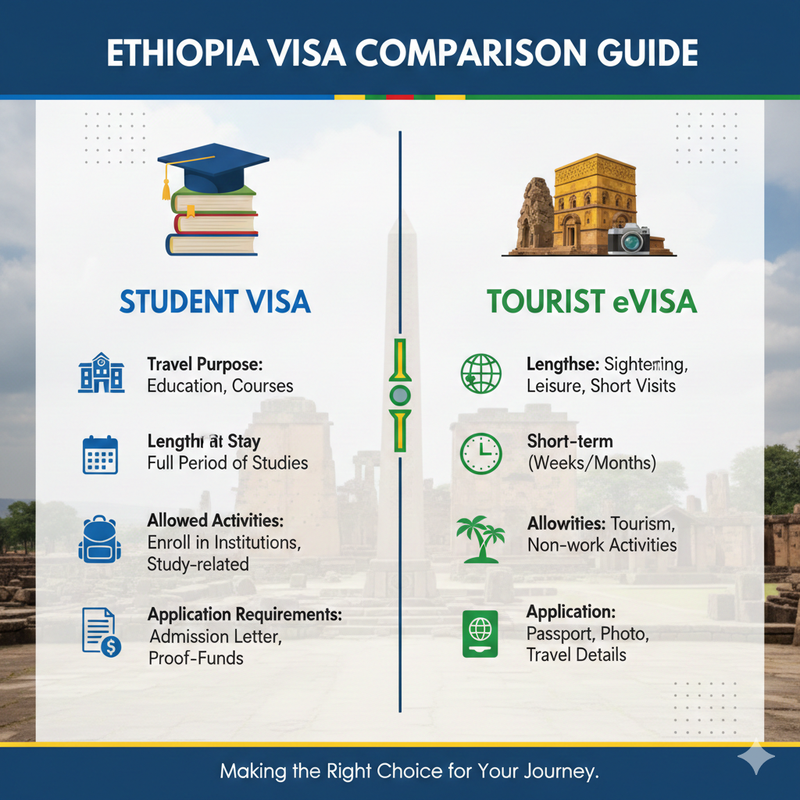
While scheduling a visit to Ethiopia, figuring out the difference between a student visa and a tourist eVisa is a must. Here is a bright explanation:
Travel Purpose:
- Student Visa: To go to school or attend courses in Ethiopia.
- Tourist eVisa: To Ethiopia for sightseeing, leisure travel, or short visits.
Length of Stay:
- Student Visa: It is often valid for the whole period of studies or for long-term stays.
- Tourist eVisa: It is generally valid for a short period, usually a couple of weeks or months.
Allowed Activities:
- Student Visa: It permits the signing up of educational institutions and study-related activities.
- Tourist eVisa: It is limited to tourism, sightseeing, and non-work activities.
Application Requirements:
- Student Visa: It comes with an institution's admission letter and sometimes the proof of money.
- Tourist eVisa: It is accompanied by basic travel documents such as a passport, photo, and travel details.
This comparison visa know-how helps travelers to make the right choices based on their purposes in Ethiopia.
Do I Need Travel Insurance for Ethiopia?
Going to Ethiopia is surely a thrilling experience, but out of the blue, such places bring unforeseen situations. Travel insurance will give you peace of mind when you are on the road although following it might not be mandatory. This is why it is important to have a look at the brief summary below:
- Travel insurance is usually not an obligatory condition for entry, however, it is a highly advised measure.
- It is a medical coverage instrument that keeps people safe in the event of sickness, accidents, or other medical emergencies.
- Trip protection: It is a resource that helps the users when their flights get canceled, delayed, or their luggage is lost.
- A financial safety tool that helps eliminate the risk of incurring unplanned expenditures while abroad.
- Peace of mind: A great tool that provides a traveler's dream of a worry-free and seamless journey.
Thus, travel insurance will be a wise move as a preventive measure for every Ethiopia traveler.
Is an Ethiopia eVisa Required for Children?
Yes, children going to Ethiopia are required to have an eVisa just like adults. This is to make sure that all the people coming into the country are allowed. Here is a simple explanation:
Compulsory for Everyone: Any traveler, even infants and minors, has to have an eVisa.
Different Application: A separate eVisa application is needed for each child.
Additional Documents: Children might be required to give some extra documents like a birth certificate and a parental consent letter.
Confirmation at the Border: The immigration officers will look at the eVisa along with the child's passport when you arrive.
Travel Ready: It is very important to have the child's eVisa at hand to be sure that there will be no waiting time at the airport.
Making sure that children have their own eVisa is one of the ways to be certain that the entry into Ethiopia will be without any problem.
How Much is the Ethiopia eVisa Fee?
While the exact amount for an Ethiopia eVisa Fee can vary, it’s important to be aware of the fee without focusing on the price. Here’s a point-wise guide:
Mandatory Payment: An eVisa application requires a processing fee that must be paid online during the application.
Non-Refundable: The fee is generally non-refundable, even if the eVisa is denied.
Payment Methods: Most applications accept secure online payment options like credit or debit cards.
Validity Based on Fee: The type of eVisa (single or multiple entry) may determine the processing fee category.
Confirmation of Payment: Ensure your payment is successfully processed to avoid delays or rejection.
Include in Travel Budget: Always account for the eVisa fee as part of your travel planning.
This helps travelers prepare for the eVisa process without focusing on the exact cost.
How Safe is Ethiopia for Tourists?
Ethiopia is a lovely country with a rich past and culture, which makes it a popular destination for tourists. Although it is mostly safe, one should be careful and keep updated on the situation. Here is a list of tips in the form of points:
Popular Areas: Major cities and tourist spots are considered safe for travelers.
Regional Awareness: There might be some areas that are prone to political unrest and local conflicts; thus, it is better to check the latest news before traveling.
Personal Safety: Do not go to places without people, especially at night, if you want to lower your chances of being attacked.
Valuables: Make sure that your passport, money, and electronic devices are in a safe place at all times.
Follow Local Advice: For your safety, follow the instructions given by local authorities or other trustworthy sources.
Health Precautions: Drinking enough water, eating safely, and getting the required vaccinations are some of the steps you should take.
If tourists abide by these safety rules, they will be able to have a pleasant and unforgettable experience in Ethiopia.
How Long Can You Stay in Ethiopia with an eVisa?
If you are planning a trip to Ethiopia, it is very important to know how long you can stay with an eVisa for your travel to go smoothly. Here is a very clear point-wise guide:
Validity Period: A tourist eVisa typically permits a stay of up to 30 or 90 days, which depends on the type of visa issued.
Start of Stay: The duration is from the date of your entry into Ethiopia and not from the date when the eVisa was issued.
No Overstay: If the stay is longer than the allowed time, it may bring about fines or even the impossibility to travel there again.
Passport Requirement: Make sure your passport is valid during the whole time of your stay.
Travel Planning: Make your trip plan within the time that you are allowed to stay so that you do not have any problems.
By observing these points, you are guaranteed to have a trouble-free visit to Ethiopia.
Which Payment Method is Used in Ethiopia?
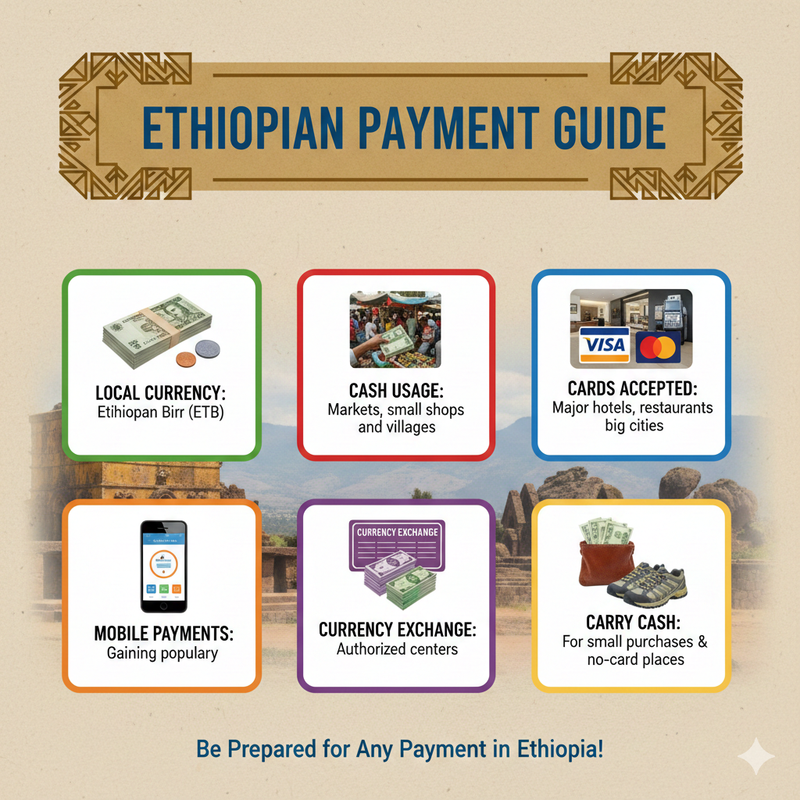
While being in Ethiopia, knowing how the locals pay their bills will keep your dealings smooth. Here is a point-wise guide:
Local Currency: The Ethiopian Birr (ETB) is the official currency used for most transactions.
Cash Usage: Cash is usually the only means of payment in markets, small shops, and villages.
Cards Accepted: Credit and debit cards, mainly Visa and Mastercard, can be used in major hotels, restaurants, and stores in big cities.
Mobile Payments: Mobile payment services are gaining popularity as a convenient transaction method.
Currency Exchange: Do your money exchange at authorized centers for both safety and good rates.
Carry Cash: It is advisable to have some cash with you for small purchases or places where cards are not accepted.
Thus you are prepared for any kind of payment while being in Ethiopia.
What Are the Rules for Immigration to Ethiopia?
Going to Ethiopia involves the observance of particular rules set by the country's immigration department if one desires to have a good time with no trouble at all when arriving and staying there. The following is a point-wise guide:
Valid Passport: A six-month passport must be the minimum validity of the one that travelers present to the date of their entry.
eVisa Requirement: The majority of visitors will require an Ethiopia eVisa prior to their arrival, and this also applies to children.
Purpose of Visit: The first time entry should be consistent with the visa type that the person holds tour, business, or study.
Entry Check: At the airport, immigration officers check the travelers' passports, visas, and other supporting documents.
Health Regulations: Vaccination certificates may be required from travelers, or they may have to undergo certain health checks.
Not Overstaying: People should be within the stay period of the visa used at the time of entry if they do not want to be subjected to pay a fine or face other restrictions like not being allowed to travel.
Prohibited Items: Some goods are restricted, so it is better to be informed beforehand to get rid of the risk of having them confiscated.
By complying with such requirements, one is assured of easy access to Ethiopia with no worries of any kind.
How Do You Get Access to Your Ethiopia eVisa?
Getting access to your Ethiopia eVisa is essential for a smooth entry into the country. Here’s a point-wise guide:
- Approval Notification: Once your eVisa application is approved, you will receive an email confirmation.
- Download Option: Download the eVisa from the email to your computer or device.
- Print Copy: It is recommended to print a physical copy for presentation at immigration.
- Digital Copy: Keep a digital version on your smartphone or tablet as a backup.
- Presentation at Airport: Show your eVisa along with your passport to immigration officers upon arrival.
- Multiple Copies: Having extra copies ensures you are prepared in case of loss or device issues.
This helps ensure hassle-free entry into Ethiopia.
Do I Need an Ethiopia eVisa if I Have a Connecting Flight?
Yes, whether you need an Ethiopia eVisa during a connecting flight depends on whether you leave the airport’s international transit area.
- Transit Without Leaving Airport: If you stay in the international transit area and do not pass through immigration, an eVisa is generally not required.
- Leaving the Airport: If you plan to enter Ethiopia, even for a short time, you must have an eVisa.
- Check Airline Policy: Some airlines may require an eVisa regardless of transit duration, so confirm before traveling.
- Airport Transfer Rules: Be aware of the airport’s transit regulations to avoid unexpected issues.
It’s always safer to verify your transit requirements before your trip to Ethiopia.
Which SIM Card is Best for Ethiopia?
Being online in Ethiopia is a must if you want to move around, talk to people and of course, do general traveling. Let me explain to you the best SIM kit in bullet points:
Ethio Telecom. It is the provider that is most commonly used and has a very wide coverage throughout the country, thus it is the best choice if you are planning to go to the villages or the small towns besides the big cities.
Safaricom Ethiopia. It is a nice alternative option and it offers a very good 4G connection in cities and also it is very easy to use for mobile banking services.
Airport SIM Purchase. There you will be able to buy the most convenient and cheapest prepaid SIM cards that also are loaded with data bundles at the very same airport you arrive in Addis Ababa Bole Airport and at the other big airports.
eSIM Options. What is eSIM? It is a virtual SIM card and if your phone has this feature then you can activate an eSIM plan anytime and anywhere thus you don't have to wait long to get data access.
Data Plans & Top-Ups. It has never been so flexible in buying data bundles and top-ups can be done easily in every corner of the country by either local stores or by using some mobile apps.
Passport Registration. In order to own a SIM kit in Ethiopia, you must have a valid passport and that will be used as an identification document upon registration.
The selection of perfect SIM cards will make your trip comfortable and will remove any hassle that may occur during your travel.
What Adventures Can I Experience in Ethiopia?
Ethiopia has the vast way of exciting travels and also the rich, immersive local cultural experiences:
Go deep into a past of ancient historical sites such as the rock-hewn churches of Lalibela.
Hike the Simien Mountains or the Bale Mountains to be amazed by the nature around you.
Visit Lake Tana and the stunning monasteries that frame it.
Eat what the locals eat and take part in coffee ceremonies which are a reflection of the rich culture.
Wildlife lovers can go on safari tours in the national parks.
Such adventures make Ethiopia a top place to visit for people who love nature and history.
Frequently Asked Questions (FAQ)
1. Can I extend my Ethiopia eVisa?
No, an eVisa is usually only valid for one entry and for a limited period. If you want to stay longer, you need to get a special permission.
2.Is it safe to travel to Ethiopia for Swedish citizens?
Yes, Ethiopia does not pose any significant safety risks to tourists. Just follow the local rules and check for any advisories before traveling.
3.Can I enter Ethiopia without an eVisa?
No, a valid eVisa is mandatory for all Sweden citizens unless they are officially exempted.
4.Can I use my eVisa at any port of entry?
Sure, but your port must be one that facilitates eVisa transactions. Most international airports and seaports are eVisa compatible.
Conclusion:
Travel can be well organized and stress-free if a Swedish citizen who intends to come to Ethiopia applies for an eVisa. There is time saved and the waiting in long queues at the points of entry is avoided through the online process. By having correct documents and fulfilling all the requirements, travelers will be able to enter Ethiopia without any problems. With the eVisa, travelers can be sure to have an easy and safe stay while they discover the cultural heritage, the historic sites, and the splendid nature of the country.
Comments