Watering a large property is very different from maintaining a small lawn. Farms, athletic facilities, parks, construction sites, and other large open areas need irrigation equipment that can cover considerable distances without requiring a permanent sprinkler system everywhere.
Portable irrigation reels offer one practical way to handle these situations. They combine a long irrigation tube, sprinkler cart, and controlled retraction system to distribute water over large areas while allowing the equipment to be moved between locations.
Understanding how these systems work can make it easier to decide whether a portable irrigation reel fits a particular property.
What Is a Portable Irrigation Reel?
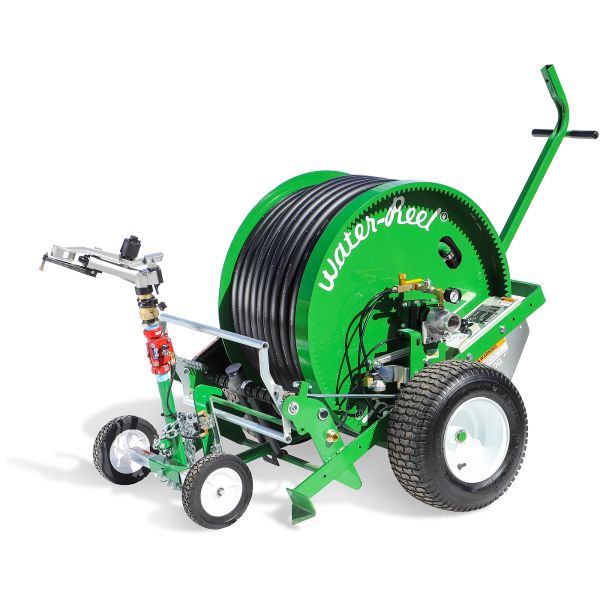
An irrigation reel is a mobile watering system designed to distribute water across a large area.
A typical setup includes a reel containing polyethylene tubing, a sprinkler or gun cart, a drive system, and connections to the property's water source.
The sprinkler cart is pulled to the far end of the area that needs watering. As the system operates, the reel gradually retracts the tubing and moves the sprinkler back toward the machine.
This allows water to be applied across a long strip of land without workers constantly moving sprinklers by hand.
Where Irrigation Reels Are Commonly Used
Portable reels can serve many different applications because they do not require permanent underground piping across the entire watering area.
Common uses include:
- Agricultural fields
- Pastures
- Sports fields
- Parks and recreational areas
- Large turf properties
- Construction sites
- Dust-control projects
- Wastewater land application
The same general concept can be adapted to different locations by selecting the appropriate reel size, sprinkler, pump, hose length, and water-delivery rate.
Why Portability Matters
One major benefit of reel irrigation is the ability to move equipment.
A permanent irrigation system normally serves a fixed area. A portable reel can often be repositioned to water several fields or sections of the same property.
For example, a facility with multiple athletic fields may use one reel in different locations rather than installing a complete underground irrigation system for every field.
Farm operators can also move irrigation equipment between sections based on crop schedules, soil moisture, and seasonal watering needs.
This flexibility can be particularly useful where watering requirements change throughout the year.
Match the Reel to the Size of the Area
Not every irrigation reel is designed for the same amount of land.
Smaller units may work well for turf areas, hobby farms, or compact properties, while larger machines are built for greater distances and higher water-flow requirements.
Before choosing a reel, it helps to know:
- Length of the irrigation run
- Desired watering width
- Available water pressure
- Available water flow
- Total acreage
- Soil conditions
- Water source location
- Frequency of irrigation
Property owners researching a Kifco water reel for sale can compare different reel sizes, tube lengths, flow ranges, drive systems, and coverage capabilities before choosing equipment for a particular application.
Water Pressure Is an Important Factor
Coverage does not depend only on the size of the reel.
The sprinkler also needs enough pressure and water flow to operate correctly. Without sufficient pressure, the sprinkler may not reach its expected coverage area or distribute water evenly.
This is why the water source should be evaluated before equipment is selected.
Some properties have adequate pressure from an existing system. Others may require a pump to deliver the necessary flow and pressure.
Looking at the reel, pump, sprinkler, and water source as one complete irrigation system can prevent performance problems.
Consider Soil and Water Application Rates
Different soils absorb water at different rates.
Sandy ground usually allows water to move through the soil relatively quickly. Heavy or compacted soils may absorb water more slowly and can experience runoff if water is applied too rapidly.
An irrigation reel should therefore be operated at a speed and application rate that matches local conditions.
The goal is to give the soil enough time to absorb the water rather than simply applying the largest possible amount.
This can improve irrigation efficiency while reducing pooling and runoff.
Turbine and Engine-Driven Systems
Portable irrigation reels can use different types of drive systems.
Turbine-driven units use water moving through the machine to power the reel's retraction mechanism. Engine-driven models use a separate engine to handle retraction.
Each setup has different operating considerations.
The best choice can depend on available pressure, water supply, required flow, field conditions, and how the equipment will be used.
Instead of choosing based only on price or machine size, operators should consider the entire irrigation setup.
Sprinkler Selection Also Affects Coverage
The sprinkler attached to the cart has an important role in system performance.
Different sprinklers can provide different flow rates, operating pressures, throw distances, and water patterns.
A sprinkler suited for one field may not necessarily be ideal for another.
Wind conditions should also be considered. Strong winds can affect large sprinkler patterns and make watering less uniform.
Choosing the sprinkler together with the reel and pump helps create a more balanced system.
Portable Systems Can Reduce Manual Labor
Large properties can require significant labor when small sprinklers have to be moved repeatedly.
A reel system can reduce this work because the sprinkler automatically moves across the irrigation run as the tube retracts.
Staff still need to position the equipment, connect the water supply, and monitor operation, but they do not have to manually reposition a sprinkler every few minutes.
For farms, turf facilities, and large properties with limited maintenance staff, this can make watering more manageable.
Think About Equipment Access and Movement
Portability only helps when the equipment can move safely around the property.
Before selecting a reel, consider gates, roads, slopes, field entrances, soft ground, and available towing equipment.
Larger irrigation machines need more room for transportation and positioning than smaller units.
Planning how the reel will move between irrigation areas is just as important as calculating its watering capacity.
Maintenance Should Be Part of the Decision
Irrigation equipment operates around water, pressure, moving components, and outdoor conditions, so routine inspection matters.
Operators should periodically check hoses, connections, tires, drive components, sprinklers, and other moving parts.
Keeping replacement parts available can also reduce downtime during periods when irrigation is especially important.
Choosing equipment with accessible parts and technical support can make long-term ownership easier.
Conclusion
Portable irrigation reels can provide an efficient way to water large areas without installing permanent irrigation infrastructure across every part of a property.
The right system depends on more than acreage alone. Water pressure, flow, soil, sprinkler selection, irrigation distance, portability, and operating requirements should all be considered.
When these factors are matched correctly, a portable irrigation reel can provide reliable coverage while giving property managers the flexibility to move their irrigation equipment wherever it is needed.
Comments