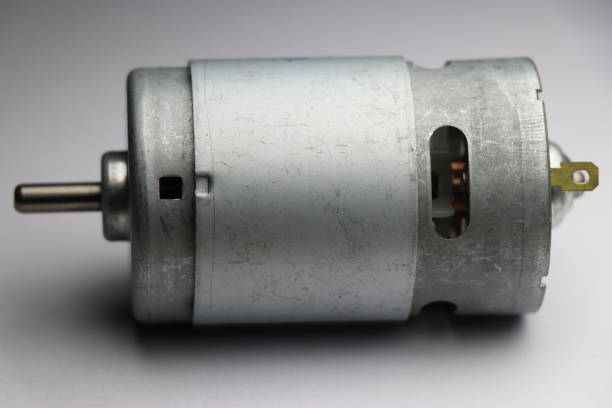
A pump seems simple. Liquid goes in, liquid comes out, and the motor just turns. In practice the motor feels every change in pressure, every blocked filter and every long run on a warm day. Choosing it well takes more than picking a voltage and hoping for the best.
Why Pumps Are Harder Than They Look
Water pumps and electric sprayers need stable speed under load and often run for long periods. That combination is demanding. A motor that looks fine on the bench with a free shaft can behave quite differently once the pump head resists it.
As load torque rises, motor speed falls and current increases. That is true of every brushed DC motor, and it explains why advertised no-load rpm is a poor guide for pump work.
Start With the Working Point
Write down the torque your pump needs while running normally, and the speed it needs at that torque. Use the supply voltage the product will really have, not the figure printed on the charger.
Then look for a winding whose maximum-efficiency point sits near your numbers. At that point speed, current, torque, output power and efficiency are stated together. Running near it keeps wasted energy, and therefore heat, lower.
Matching Voltage and Winding
MGLORY lists configurable voltage from 6 V to 36 V for the RS775 family. The guide gives two reference windings that show why the winding matters more than the supply alone.
An 18 V winding runs at 21,000 rpm with no load and delivers 259 W at its maximum-efficiency point. A 24 V winding runs at 7,000 rpm with no load and delivers 37 W at its own. Higher voltage did not mean higher output. The winding decided that.
For a pump, a slower, steadier winding may suit the load better than a fast one, depending on the pump design. The point is to choose from the curve, not from the headline speed.
RS775 or RS750
The guide's direction for pumps and sprayers is clear. Choose the RS775 for higher output, and the RS750 for a lighter load. Neither is automatically better. A lighter motor saves weight and space when the load truly is light, while the larger frame gives more thermal capacity when the load is heavy.
If you are unsure, test both with a real pump head. Measure loaded current and temperature rise carefully on both.
Plan for Continuous Duty and Heat
Long pump runs are where heat becomes the main risk. The RS775 carries an internal cooling fan that provides airflow while the motor rotates, but that fan only helps if air can circulate. Do not seal the motor inside a tight pocket.
Stall deserves special attention in pump products. A blocked outlet or jammed impeller can stop the shaft. Stall current is very high and heats the motor quickly, so the circuit should protect against it. Stall torque is a short-duration limit, never an operating target.
Also consider where moisture and dirt can reach. Dust, moisture, fibres and metal particles are all worth listing in your design review.
What the Paperwork Should Show
A usable rs775 dc motor datasheet gives test and rated voltage, loaded speed, torque and current, stall values, winding resistance, ambient test temperature and duty cycle. Those items let you compare a candidate motor with your pump's real demands.
If the supplier can only offer a single power figure, ask for the speed-torque-current curve as well. A pump spends its life at many loads, not one.
Test Like Your Customer Will Use It
A sample that hits the expected no-load speed can still overheat or stall in the finished product. Test with the pump head fitted, at the real supply voltage, for the real run time. Record loaded current and temperature rise, and keep the rs775 datasheet beside your test log so each reading can be compared with the stated operating point.
Then try the abuse cases: a partly blocked nozzle, a cold start, a long continuous run. These are the conditions customers create.
Keep the Electronics in the Loop
A pump motor never works alone. It sits behind a switch, a battery or a power supply, and sometimes a controller. Each of those affects what the motor actually receives.
Check that the wiring and connectors can carry the loaded current comfortably, not just the no-load figure. Confirm what happens to supply voltage as a battery drains, because speed follows voltage. And make sure the protection circuit trips before stall current has time to heat the motor.
Conclusion
Pump and sprayer motors succeed when they are chosen by working point, protected against stall, given room to breathe and validated under real load. Start with the curve, pick the frame that matches your output needs, and treat every sample as an experiment rather than an approval.
Comments