If you have had enough of the boring touristy places and you are dreaming of a very exotic destination then this one is for you. A small country on the horn of Africa is silently welcoming the year 2026 as the "it" place for the adventurous, photographers, and nature lovers. Djibouti, a land where the earth literally rips itself apart, gives you a view so out-of-the-world that you might think you accidentally landed on Mars. In this guest post, we are going to walk you through the most breathtaking places in Top Attraction in Djibouti for 2026. No matter if you are going solo or planning a unique family holiday, you will find all the secrets of Africa’s best-kept amazing spot!
Why Should You Visit Djibouti?
Djibouti is an amazing travel spot where breathtaking vistas, rich culture and adventure come together. It is a small but impressive country that has pretty much the same unique experiences as nowhere else.
- Such fantastical nature that nature has been sometimes described as the source of all these mirages featuring salt lakes, lava fields and desert lands which are to the eye unbelievable
- Lake Assal - at the very bottom of Earth - with its magical white salt formations and marvellous views
- Immaculate beaches and underwater gardens by the Red Sea, a paradise for snorkelling, diving and aquatic life discovery
- Meeting with very few animals including the giant whale sharks during their wanderings at certain times of the year
- African, Arab, and French cultures’ influences in local food, markets, and even daily life are all mingled in
Less visited spots that is why it is so ideal for serenity seekers and non-touristy places lovers
To visit Djibouti is to go on a roller coaster ride of adventure, beauty in nature, and diversity of culture packed into one unforgettable journey.
How long does it take to get a visa for Djibouti?
This part discusses the different timelines that are available for application review. Applicants will have the chance to choose the option that best fits their urgency for the result.
- Normal Processing (4 – 7 Working Days)
- The choice for those travelers who are organized in advance and do not mind the standard review time.
- Rush Processing (3 – 5 Working Days)
- The choice for those who need a faster service than the standard one.
- Super Rush Processing (2 – 4 Working Days)
- The most rapid option, best suited for those whose travel plans are very urgent and need to be prioritized.
Selecting the most appropriate processing time will assist in coordinating your application with your travel plans.
Which documents are required for djibouti eVisa?
This section is used to upload essential documents needed to support your application. Make sure all files are clear, complete, and readable before uploading.
- Passport Bio Page
Upload a clear copy of the passport page that shows your personal details and photograph. - Applicant Photo
Provide a recent photo with a plain background and clear facial visibility. - Ticket or Reservation
Submit a copy of your confirmed or planned travel reservation showing your journey details. - Hotel Booking or Invitation Letter
Upload proof of accommodation or an invitation from a host confirming your stay.
How Was Lake Assal Formed?
Lake Assal was formed through powerful geological and volcanic activity over thousands of years. The lake lies in a deep depression created by movements in the Earth’s crust, where tectonic plates slowly pulled apart. This caused the land to sink below sea level.
- Tectonic rifting created a low basin in the Afar region
- Volcanic eruptions and lava flows shaped the surrounding landscape
- Seawater seepage and evaporation left behind high salt deposits
- Extreme heat and dry climate caused water to evaporate faster than it could refill
Over time, these natural processes turned Lake Assal into one of the saltiest lakes on Earth, known for its striking white salt flats and dramatic scenery.
Is Djibouti Expensive for Tourists?
Djibouti is largely seen as an expensive place for tourists, especially when compared to a number of other African destinations, however, prices will depend on the travel style and the level of planning.
- Accommodation: There are very few hotels and lodges, hence the room prices are usually quite high. The less expensive choices have limited availability, while stays of good quality can be quite expensive.
- Food: A local meal is not too expensive, but eating in hotels or places that cater to tourists is costly.
- Transport: It is cheap to use local transport within cities, but going to see the natural attractions often calls for private vehicles which adds to the expenses.
- Activities: The overall budget could be increased because popular activities such as desert trips, lake visits, and marine activities could become part of the travel experience.
- Daily expenses: Higher prices might be seen by tourists as a result of imports and the limited tourism infrastructure.
In general, Djibouti is not a budget-friendly destination, but those opting for local food, simple stays, and well-planned activities can bear the costs more easily.
How Accessible Is Lake Abbe to Tourists?
Lake Abbe is a destination for the adventurous; however, it is not easy to access as the popular city attractions. It is located in a deserted part of Djibouti close to the Ethiopian border and requires thoughtful planning and reliable transport to get there.
- 4×4 Vehicle Necessary: The roads leading to Lake Abbe are harsh and at times very muddy, thus a 4×4 vehicle along with a skilled driver is a must.
- Organized Tours: A large number of tourists cover the trip via guided tours that come with transportation, meals, and local guidance.
- Distance from Main Towns: The distance makes it a long ride, so travelers typically schedule a day and a half or two days for the trip.
- Basic Amenities: The facilities around are very limited, so it would be wise to take along some water, snacks, and other supplies.
In conclusion, Lake Abbe is an offbeat and challenging destination but is ultimately a rewarding experience for those who dare to take the plunge and are even willing to go where most tourists have not been.
Are There Sharks in Djibouti?
Yes, sharks can be found in the waters around Djibouti, especially in the Red Sea and the Gulf of Tadjoura, but they are generally not dangerous to tourists.
- Whale sharks are the most famous visitors and are often seen seasonally; they are gentle and harmless
Other shark species may live deeper offshore and usually avoid human activity - Shark sightings near beaches are rare, making swimming and snorkeling safe in designated areas
- Marine activities are well guided, helping visitors enjoy the sea responsibly
- Djibouti is known more for safe marine encounters than for aggressive shark behavior
Overall, sharks are part of Djibouti’s rich marine ecosystem, and encounters especially with whale sharks are considered a highlight rather than a risk for tourists.
Where Is Day Forest National Park?
Day Forest National Park is situated in the northernmost part of Djibouti, and it spans over the Godda Mountains, which are part of the Tadjourah region. The park's elevation is higher than that of most of Djibouti, thus, the cooler and greener environment that it experiences is different from the desert areas surrounding it.
- North of Djibouti city, a road trip is necessary with some planning.
- Mountainous area close to the Gulf of Tadjoura.
- One of the few places in Djibouti that has a forest.
- Plants and animals unique to the region are found in it.
Day Forest National Park is a place of high altitude and natural beauty that gives a cool and refreshing experience in contrast to Djibouti's dry and barren lands.
How Safe Is It to Travel to Djibouti?
Djibouti is commonly regarded as a tourist destination that is safe, particularly when the basic travel precautions are observed. The country is politically stable and welcoming to the tourists.
- Main tourist areas have low crime rates, and incidents with travelers are very rare
- The people are friendly and hospitable and they are used to the presence of foreigners
- It is safe for solo travelers, even women, provided they dress modestly and are aware of their surroundings
- The police and security forces are present in the cities and at important spots
- Knowledge about health and the climate is necessary because of the heat and the remote nature of the areas
Traveling with a guide is recommended for the deserts, lakes, and other remote places
To sum it up, Djibouti is a safe and peaceful place to visit, especially for those who stay updated, give respect to the local ways, and plan their trips wisely.
What Is the Cultural Tradition of Djibouti?
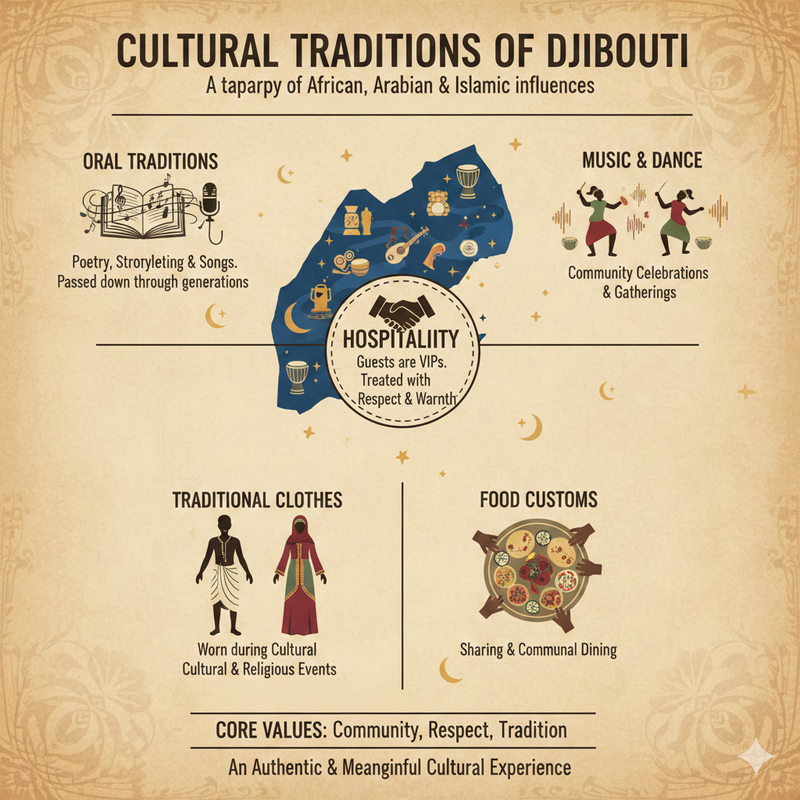
The cultural practices of Djibouti showcase a diversity of African, Arabian, and Islamic influences, which are a result of its historical position as a trading and migratory route.
- Oral traditions that are strong, like poetry, storytelling, and songs have been passed down through generations
- Music and dance are some of the main aspects of the community celebrations and gatherings
- Guest are considered as very important persons and are always treated with respect and warmth
- People frequently wear traditional clothes, mostly during cultural and religious events.
- Food customs revolve around sharing and dining together.
- Djibouti's culture is composed of community, respect, and tradition, thus, giving visitors an authentic and significant cultural experience.
How Much Is the eVisa Fee for Djibouti?
The Djibouti eVisa Fees requires a processing fee that must be paid when submitting your application.
The cost varies depending on your nationality and the type of visa you are applying for for example, short?term tourism, business, or transit purposes.
The fee is paid online as part of the application process, and only after payment will your eVisa be reviewed and issued. Since prices can change over time and differ by passport, it’s important to check the current fee applicable to your nationality before you apply.
In short, there is a fee for the eVisa, and you should expect to pay it during the online application step based on your travel plans and passport country.
What Do You Need to Go to Djibouti?
If you get the basic requirements done beforehand, you can easily travel to Djibouti. Most travelers need the following items:
- Passport with validity that covers the whole stay
- Visa which in most cases travelers get before arrival or by means of e-visa application
- Confirmation of return or onward travel to provide evidence of travel plans
- Proof of accommodation in the form of a hotel booking or stay details
- Money that is enough to cover all costs during the trip
- Basic health precautions, including routine travel vaccinations
- Light and modest clothes that are comfortable in both the climate and the local customs
If you have these items, then traveling to Djibouti can be an easy and non-stressful experience and you can concentrate on taking in the wonderful landscapes and cultures of the country.
Do You Need a Yellow Fever Vaccine for Djibouti?
Yes, a yellow fever vaccination is required for travelers arriving from countries where yellow fever is present.
- Mandatory if coming from a yellow fever endemic country; a vaccination certificate may be requested at entry
- Not required for travelers from countries without yellow fever risk
- Other recommended vaccines include hepatitis A, typhoid, and routine immunizations
- Consult a travel clinic before your trip to confirm requirements based on your travel history
Following these health guidelines ensures a safe and hassle-free entry into Djibouti while protecting you from potential tropical diseases.
How Can I Get a Djibouti eVisa?
Getting a Djibouti eVisa is hassle-free and can be done in a matter of minutes online, prior to your trip.
Step by step:
- Fill out the online application form with your personal data, passport details, and travel itinerary.
- You will have to upload the following documents:
- A passport that is valid for six months
- A recent passport-sized photo
- A hotel booking confirmation or an invitation letter
- Flight reservation or a ticket for the return journey
- The eVisa charge is to be paid online via a credit or debit card.
- You will get the eVisa via email, and then you can print it out to show it at the airport when you arrive.
- Traveling with the eVisa in hand is a must and it is valid for entry for tourist, business, or transit purposes. An early application guarantees a hassle-free entry.
What Is the Payment Method in Djibouti?
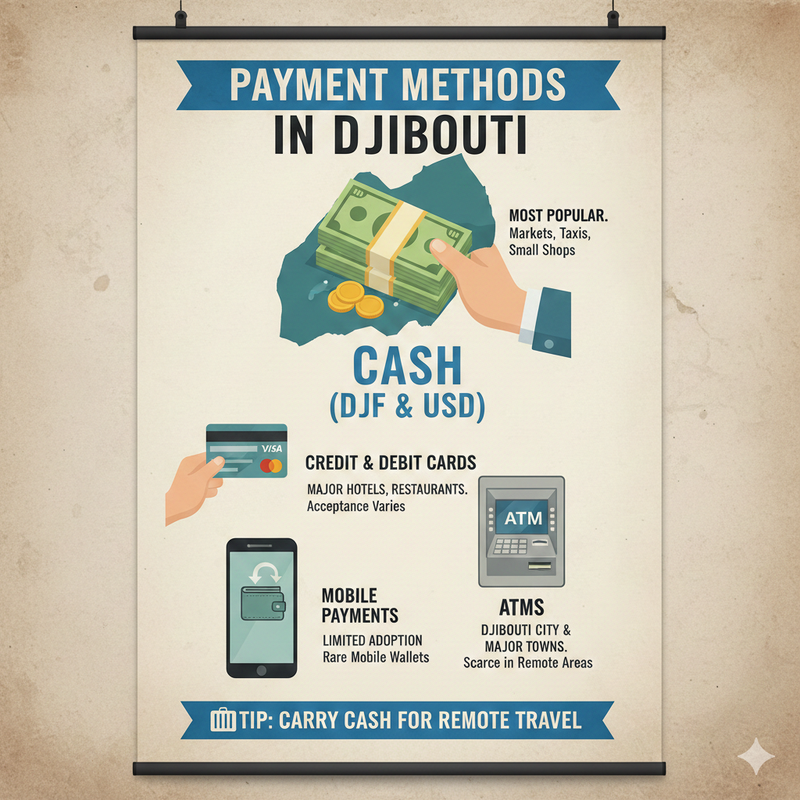
Different payment methods are in use in Djibouti, even though cash is still the most popular one all over the country.
- Cash (Djiboutian Francs and US Dollars): The majority of the markets, taxis, and small shops are cash-preferring. local currency very much so along with the US dollar.
- Credit and Debit Cards: They are accepted in most major hotels, restaurants, and some bigger shops; however, the acceptance isn't universal. Visa and MasterCard are the ones that are mostly preferred.
- Mobile Payments: The adoption of mobile payments is very limited; mobile wallets are rare and thus cash is used mainly for smaller transactions.
- ATMs: The cities like Djibouti City have ATMs for withdrawing local currency or dollars; however, they are hard to find in remote areas.
- Tip: It is advisable to have a sufficient amount of cash with you when you are traveling to less accessible places or natural attractions since card facilities are very limited in such cases.
Does eSIM Work in Djibouti?
To answer the question, eSIM can be used in Djibouti, but there are some crucial points to think about:
- Presently, the local operators are not providing any eSIMs officially, thus you can not get a local eSIM after reaching there.
- You can buy international travel eSIMs which are valid for Djibouti, hence giving you access to mobile data, before your trip.
- Most of the eSIMs for travel are data-only; voice calls and SMS are usually through internet applications, for example, WhatsApp or Telegram.
- eSIMs have great connectivity in the cities, and the main towns, but in the remote areas, there might be a lack of signal.
To conclude, eSIM is workable if it is taken care of before traveling, but the eSIMs are not directly available from the local operators.
What Do People in Djibouti Do for Fun?
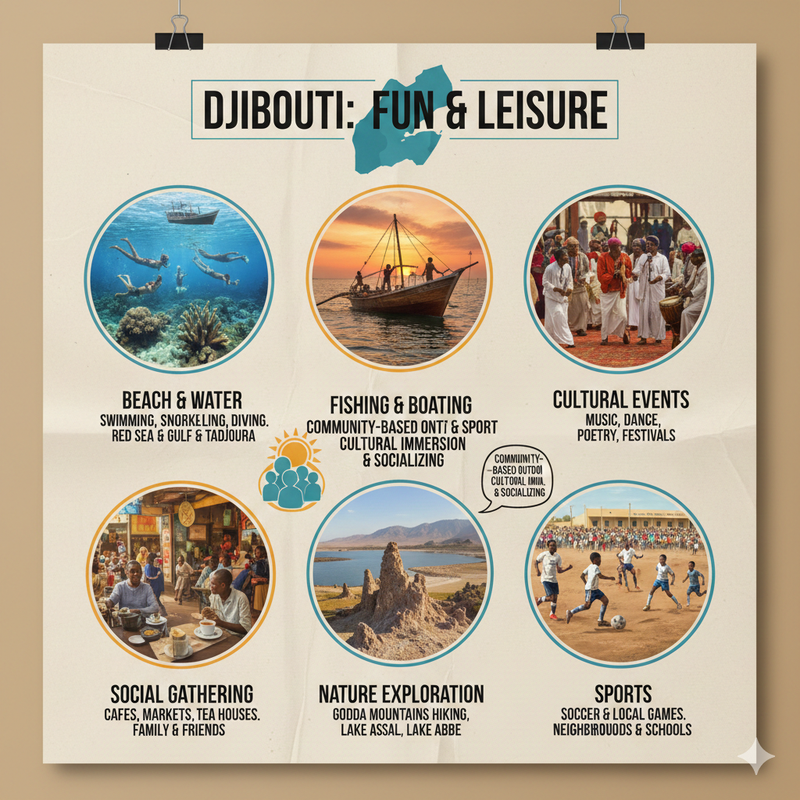
The civilians of Djibouti partake in a variety of activities that are a combination of traditional, social and nature activities which are indicative of the country’s culture and topography:
- Beach and Water Activities: Swimming, snorkeling and diving are done mainly at coral reefs in the Red Sea and Gulf of Tadjoura regions.
- Fishing and Boating: Coastal communities practice fishing and boating as both leisure and sport.
- Cultural Events: The public enjoys attending traditional music and dance shows, poetry recitals, and communal festivals.
- Social Gathering: The people love to meet family and friends at cafes, markets and local tea houses.
- Nature: The outdoors offer a variety of activities like hiking the Godda Mountains, visiting Lake Assal, or wandering through the bizarre Lake Abbe terrains.
- Sports: Soccer and other local games attract children and community in general to play and watch in neighborhoods and schools.
In Djibouti, it is a community-based approach mainly to combine outdoor fun with cultural immersion and socializing.
Conclusion: Is Djibouti Worth the Journey?
Djibouti is not a place for everyone. It is meant for the type of traveler who is okay with a little dust on their footwear, who prefers solitude to the din of the city, and who wishes to witness the planet in its most unrefined, most truthful state. Djibouti continues to be a spot where one can properly 'unplug' and, at the same time, be in touch with the nature as the year 2026 approaches.The journey from the salt-laden banks of Lake Assal to the ancient peaks of Lake Abbe is one that will affect your perception of the world. The decision is not about whether you should go, but rather when you will begin to pack.
Comments